
Pulaski County Weekly Arrest Sources
No single office publishes a Pulaski County weekly arrest log. The PCSO-linked roster comes closest for fresh bookings. Sort it by arrest date. Each entry can carry a booking number, charge, bond, arresting agency, and custody status. Some entries also show a booking image. Archive depth is never guaranteed.
For a multi-day bulletin, LRPD Daily Reports is the strongest official option. Little Rock police post significant-event write-ups Monday through Friday, generally by noon. The agency flags the details as initial and subject to change. Coverage also stays limited to selected Little Rock incidents. Bookings handled by PCSO, North Little Rock, Sherwood, and other agencies are left out.
The LRPD report index shows the date-based source.
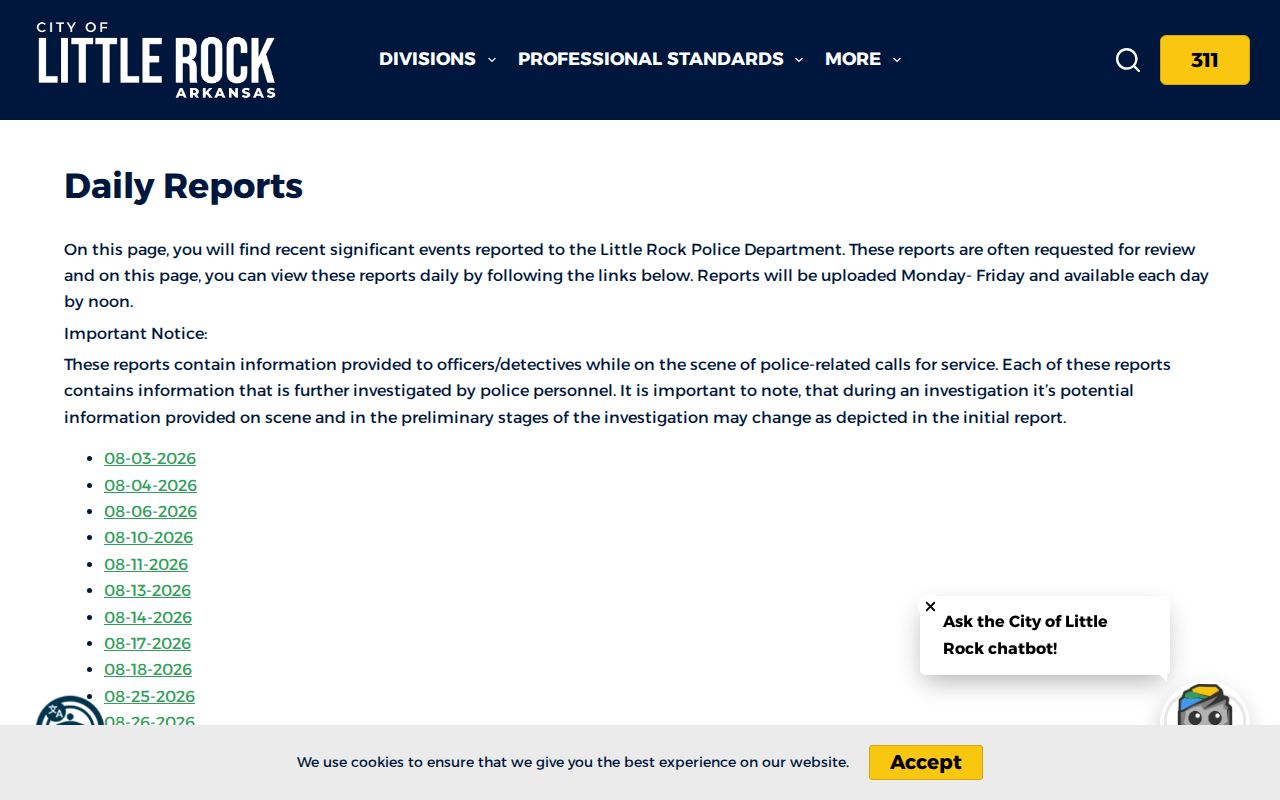
Incident context lives here. It adds color to a Pulaski County arrest. Still, it is not a booking feed. Treat it as one clue, not the whole roster.
Read Pulaski County Arrest Reports
Start with the question you are asking. Custody questions belong in the jail roster. Little Rock event summaries live in the city bulletin. Final charges and outcomes are a matter for court records.
- Open the LRPD report index and select the relevant publication date.
- Check the incident date because publication and event dates may differ.
- Read the initial-information warning and identify the reporting agency.
- Search the PCSO roster for a related adult PCRDF booking.
- Use a case number in Search ARCourts for disposition.
For the newest roster entries, open the Daily Arrest Report. It sorts recent bookings first. Treat it as a same-day proxy for activity. It is not a certified 24-hour export of every Pulaski County arrest.
Pulaski Arrest Log Fields
A news bulletin and a booking record do not return identical fields.
| Field | Meaning and limit |
|---|---|
| Incident date and description | Possible LRPD context; initial facts can change. |
| Agency | Who reported or made the arrest. |
| Name and booking ID | Roster identity fields when supplied. |
| Arrest and booking dates | Separate stages with different times. |
| Charges and case number | Charges and a route to court. |
| Bond and custody | Changing pretrial information. |
| Photograph | Possible on the roster; not guaranteed in a report. |
Not every photo attached to an arrest story is a booking photograph. Check the caption. Check the source too. A mugshot comes from jail intake, while a scene image or press photo is something else entirely.
Weekday Reports Versus Bookings
LRPD Daily Reports are built around events. A write-up may describe a significant call or arrest yet leave out bond, release status, and the booking number. The PCRDF roster works the other way. It lists a booking with no incident narrative. Neither view replaces the other.
PCSO News and city channels post updates when an event is newsworthy. Local outlets such as the Arkansas Democrat-Gazette, KATV, KARK, THV11, and Arkansas Times also cover selected stories. News coverage is never complete, and the photographs vary.
The PCSO news source documents the sheriff's own incident channel.

Use it for first-party context. Then check PCRDF for custody. Court records settle the case details. Layered sources beat guesswork every time.
Pulaski Arrest Archives and Retention
A vanished bulletin does not erase the record. PCSO's Inmate Records Clerk maintains files, logs, census data, and sealing notices. Arkansas Code § 13-4-404 counts photographs and detention logs among jail booking records. The statute sets a five-year retention floor, which covers storage rather than promised web access.
Request an older booking through the PCSO NextRequest portal. Include a name, an approximate date, the arresting agency, and any known ID. Little Rock incident records go through LRPD Reports instead. PCSO posts no guaranteed booking-photo fee or turnaround.
Arkansas's jail-log rule calls for intake and population logs with confinement, release, reason, classification, officer, and warrant details. That internal log is not the public roster. Records may be sealed, exempt, redacted, transferred, or unindexed.
Pulaski Arrests Require Court Review
City channels differ across Pulaski County. North Little Rock Police offers a records and FOIA kiosk but no continuous city booking roster. Sherwood Police publishes news and a live feed. Those streams are announcements, not a complete arrest log. Adult detainees moved into longer regional custody generally end up in the PCRDF system. The roster's arresting-agency field names the originating department.
Want an incident narrative? Request the originating agency's report. Detention status comes from PCSO and PCRDF. Timing matters on weekends, since a city bulletin may post days after the jail entry, and the case filing follows its own court schedule.
Unofficial county pages and local news can offer leads once official sources are checked. They may copy delayed data, keep older images, omit records, or miss a dismissal or sealing order. They are not custodians. Always verify the arresting agency.
PCRDF serves many law-enforcement agencies and courts. A city report centers on the incident. The jail entry records intake, bond, and custody. ARCourts then tracks filings and hearings. Work the chain in that order.
Search ARCourts or contact the Pulaski County Circuit Clerk for disposition.
Search Pulaski County Records
Holidays slow things down. Weekend posts lag too. When a bulletin runs late, stretch your date range to the next publication day, then weigh it against the live roster and the court docket before treating one delayed post as the full Pulaski County log.
Dates deserve care. An incident date, a report upload date, an arrest date, a booking date, a last-update time, a release date, and a court filing date can all differ. Line those events up in order instead of squeezing them into a single "arrest date." A case number can tie a booking to a later docket, though identifiers sometimes shift as a matter moves between courts.
Each office owns something different. Little Rock reports give the best city incident context. The PCSO roster shows regional jail data. North Little Rock and Sherwood records offices hold their own incident files. The Pulaski Circuit Clerk and the district courts keep separate pieces of the court trail. Ask the office that created the record, because one portal cannot prove everything.
Older jail logs usually take a written request. Name the date range first. Then list only the fields you need, whether that is the detention log, a booking entry, a release or transfer field, or a booking photograph. A narrow request lets PCSO flag any fees, exemptions, redactions, or clarification questions early. Flooding the office with years of records rarely helps. Treat any search result as a lead. Confirm it with the office that made the record.
Sponsored Results